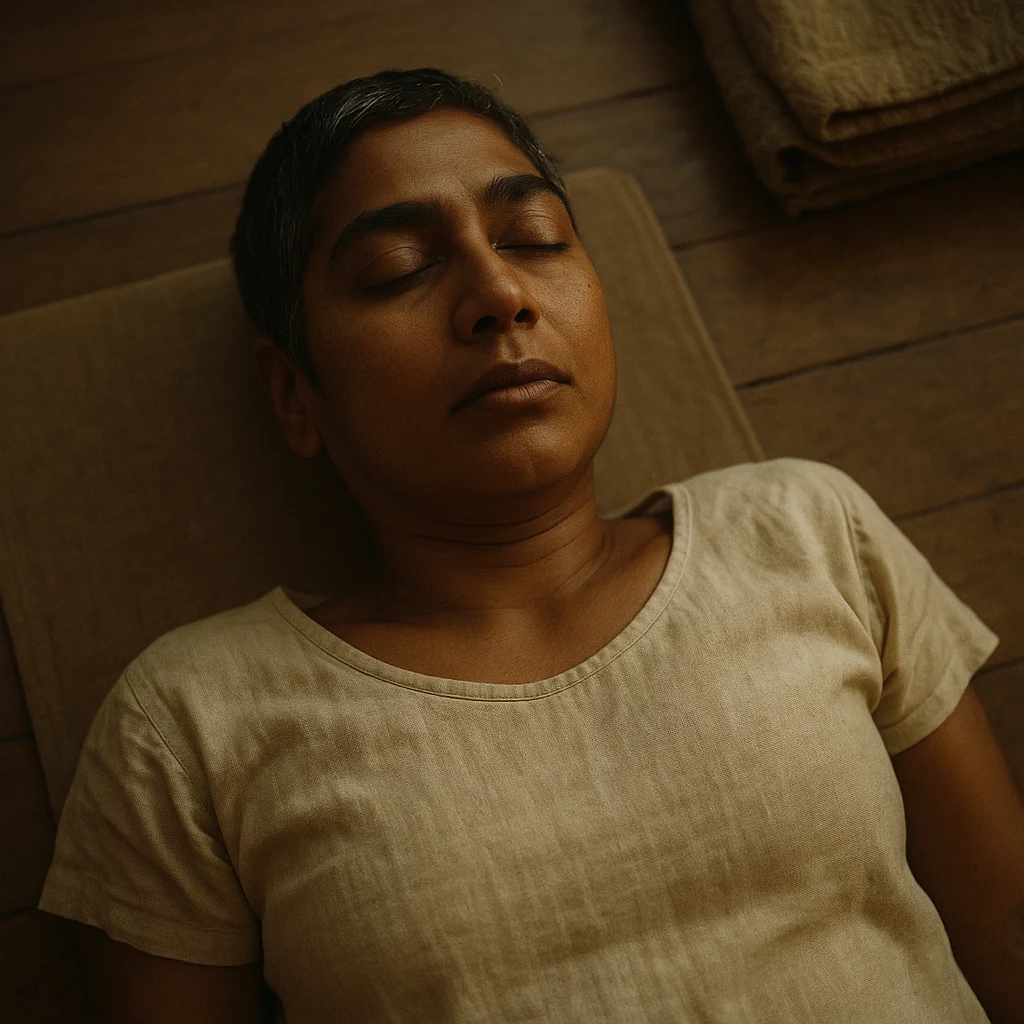

Yoga nidra is a guided deep relaxation technique, also called "yogic sleep," that induces a state of conscious rest between wakefulness and sleep. Research published in the International Journal of Yoga shows that a single 30-minute yoga nidra session reduces cortisol levels, lowers heart rate, and produces brainwave patterns associated with deep restorative sleep. Regular practitioners report that 30 to 45 minutes of yoga nidra provides rest equivalent to 2 to 4 hours of conventional sleep.
Enter yoga nidra, an ancient practice often called "yogic sleep" that bridges the gap between wakefulness and sleep. Unlike traditional meditation or sleep itself, this powerful technique guides you into a state of conscious deep relaxation where healing and restoration occur on profound levels.
This comprehensive guide reveals how yoga nidra can transform your sleep quality, reduce chronic stress, and help you access rest that actually restores your body and mind. Whether you're a parent seeking relief from exhaustion or someone battling insomnia, this practice offers a scientifically-backed pathway to the deep rest you deserve.
Yoga nidra is a guided meditation technique that induces a state between waking and sleeping, providing rest equivalent to several hours of sleep while reducing stress, anxiety, and sleep disturbances. Studies show 30-45 minutes of practice can feel as restorative as 2-4 hours of conventional sleep.
What Is Yoga Nidra and How Does It Work?
Yoga nidra is a systematic meditation technique that guides practitioners into a hypnagogic state-the transitional consciousness between waking and sleeping. During this practice, your body rests deeply while your awareness remains alert, creating unique conditions for psychological and physiological restoration.
The practice typically lasts between 20-45 minutes and follows a specific structure. A trained guide leads you through body awareness, breath observation, visualization, and intention-setting while you lie comfortably on your back.
- Yogic Sleep
- A conscious state of deep relaxation where the body sleeps while the mind remains awake and receptive, allowing access to subconscious patterns and profound rest without losing awareness.
Unlike conventional sleep or even regular meditation, yoga nidra operates at the alpha and theta brainwave frequencies. Research using EEG monitoring shows practitioners enter states typically only achieved during REM sleep, yet maintain enough consciousness to follow guidance and set intentions.
The technique works by systematically relaxing the nervous system, shifting you from sympathetic (fight-or-flight) to parasympathetic (rest-and-digest) dominance. This neurological shift triggers cascading benefits throughout your body's systems, from hormone regulation to immune function.
The Science-Backed Benefits of Yoga Nidra for Sleep
Scientific research reveals yoga nidra as remarkably effective for improving sleep quality and duration. A study published in the International Journal of Yoga Therapy found that participants practicing yoga nidra showed 73% improvement in sleep quality scores after just eight weeks of regular practice.
The practice addresses sleep issues at their root by regulating the hypothalamic-pituitary-adrenal (HPA) axis, your body's stress response system. When this axis becomes dysregulated through chronic stress, sleep architecture suffers dramatically.
Research from the Swami Vivekananda Yoga Research Foundation demonstrated that regular yoga nidra practice reduced cortisol levels by an average of 31% and increased melatonin production, the hormone essential for healthy sleep-wake cycles.
Additional benefits include:
- Reduced sleep latency: Falling asleep 15-30 minutes faster on average
- Fewer nighttime awakenings: More continuous, uninterrupted sleep cycles
- Enhanced sleep depth: Increased time in restorative deep sleep stages
- Decreased sleep anxiety: Reduced worry about whether you'll fall asleep
- Improved daytime energy: Better restoration leading to enhanced alertness
A clinical trial published in Applied Psychophysiology and Biofeedback found that 68% of insomnia patients experienced significant improvement after a 12-week yoga nidra intervention, with many reducing or eliminating sleep medication use.
How Yoga Nidra Differs from Regular Meditation and Sleep
Yoga nidra occupies a unique position in the landscape of relaxation practices, distinct from both traditional meditation and conventional sleep. Understanding these differences helps you leverage each practice appropriately for maximum benefit.
During regular meditation, you typically maintain an upright seated posture and cultivate focused attention or open awareness. The goal often involves observing thoughts without attachment while remaining in a waking state.
- Hypnagogic State
- The transitional state of consciousness between wakefulness and sleep, characterized by vivid imagery, creative insights, and heightened suggestibility-the primary state accessed during yoga nidra practice.
Yoga nidra, by contrast, deliberately induces a state closer to sleep. You lie down in a comfortable position, and the practice actively guides you toward the edge of unconsciousness while maintaining a thread of awareness. This creates access to subconscious patterns inaccessible during regular waking meditation.
Compared to sleep itself, yoga nidra offers conscious restoration. While sleeping, you lose volitional awareness and cannot direct your mental state. In yoga nidra, you can plant intentions (called sankalpa) directly into your subconscious while in this receptive state, creating powerful opportunities for behavioral change and emotional healing.
For those exploring different meditation techniques for beginners, yoga nidra offers an accessible entry point since it doesn't require maintaining difficult postures or battling racing thoughts-the practice naturally guides you into relaxation.
The Traditional Structure of a Yoga Nidra Session
Authentic yoga nidra follows a systematic progression through eight stages, each designed to deepen relaxation and access different layers of consciousness. Understanding this structure helps you recognize genuine yoga nidra practices and maximize their benefits.
The session begins with preparation and settling, where you assume a comfortable lying position (typically savasana) and begin consciously relaxing. This initial stage establishes the foundation for deeper work.
The Eight Stages of Yoga Nidra
1. Sankalpa (Intention Setting): You formulate a short, positive statement reflecting a deep personal goal or quality you wish to cultivate. This intention is planted in your subconscious during the receptive state.
2. Body Rotation of Consciousness: Systematic attention moves through each body part, progressively releasing physical tension and drawing awareness inward away from external stimuli.
3. Breath Awareness: Focus shifts to observing the natural breath without controlling it, further calming the nervous system and deepening the relaxation response.
4. Opposite Sensations: You're guided to experience contrasting sensations (hot/cold, heavy/light) which helps develop equanimity and balance the nervous system.
5. Visualization: Guided imagery activates the subconscious mind, accessing symbolic and archetypal dimensions of consciousness while maintaining deep physical relaxation.
6. Sankalpa Repetition: Your intention is revisited, now planted deeper into the subconscious soil prepared by the practice.
7. Externalization: Gradual guidance back to ordinary waking consciousness, ensuring you transition smoothly rather than jolting awake.
8. Integration: A brief period to assimilate the experience before resuming normal activities.
This structure creates a comprehensive journey through different levels of being-physical, energetic, emotional, and psychological. Each stage builds upon the previous, creating conditions for the profound rest that characterizes genuine yoga nidra.
Yoga Nidra Techniques You Can Practice Tonight
Starting a yoga nidra practice requires minimal equipment and can be done in your own bedroom. These beginner-friendly techniques provide an accessible entry point to this transformative practice.
Begin by creating an optimal environment. Choose a quiet space where you won't be disturbed for 20-45 minutes. The room should be slightly cool but comfortable, and you may want a light blanket since body temperature often drops during deep relaxation.
Basic Body Scan Technique: Lie in savasana (on your back, arms at sides, palms up, legs slightly apart). Close your eyes and take three deep breaths. Then systematically move awareness through your body: right thumb, fingers, hand, forearm, elbow, upper arm, shoulder, and so on. Spend 2-3 seconds on each part, simply noticing without judgment.
Breath Counting Method: After the body scan, shift attention to your natural breath. Count backwards from 27 to 1, one count per exhale. If you lose count, simply return to 27. This technique occupies the thinking mind while allowing deeper consciousness to relax.
Opposite Sensations Practice: Recall the sensation of heaviness in your body, as if you're sinking into the floor. Hold this for 30 seconds. Then shift to lightness, as if you could float. Alternate between these sensations several times, developing nervous system flexibility.
For those new to relaxation practices, combining yoga nidra with structured breathing exercises creates a powerful foundation for sleep improvement.
If you struggle with racing thoughts during practice, this is completely normal. Unlike concentration meditation, yoga nidra doesn't require you to stop thoughts-simply maintain awareness of the guidance while allowing thoughts to come and go like clouds passing.
Common Challenges and How to Overcome Them
While yoga nidra is remarkably accessible, practitioners often encounter specific obstacles, especially when beginning. Understanding these challenges and their solutions ensures consistent practice and maximum benefit.
Falling completely asleep: This is the most common challenge. While deep relaxation is the goal, losing all awareness means you miss the practice's transformative aspects. If you consistently fall asleep, try practicing earlier in the day, keeping the room slightly cooler, or maintaining a subtle intention to stay aware during the guidance.
Physical discomfort: Lying still for extended periods may reveal body tension or discomfort. Address this by placing a pillow under your knees to relieve lower back pressure, supporting your head appropriately, or using props under arms. Remember, yoga nidra should be supremely comfortable.
Mental restlessness: Some people experience increased mental activity initially. This paradoxical effect occurs because you're finally giving your mind space to process. Rather than fighting thoughts, acknowledge them and gently return attention to the guidance. This restlessness typically decreases with consistent practice.
- Sankalpa
- A positive intention or resolve formulated in present tense and planted in the subconscious during yoga nidra practice, functioning as a seed for personal transformation and behavioral change.
Difficulty formulating sankalpa: Your intention should be short (5-10 words), positive, personally meaningful, and stated in present tense. Rather than "I will sleep better," try "I rest deeply and peacefully." Don't overthink this-your sankalpa can evolve over time.
Parents dealing with nighttime anxiety might find meditation techniques for anxiety helpful as a complement to yoga nidra practice.
Integrating Yoga Nidra into Your Evening Routine
Strategic integration of yoga nidra into your bedtime routine maximizes its sleep-enhancing benefits. The key lies in consistent timing and creating supportive rituals around your practice.
Ideally, practice yoga nidra 1-2 hours before your intended sleep time. This allows the deep relaxation effects to settle while giving you time to transition from the practice back to light evening activities before bed. Practicing too close to bedtime may leave you so relaxed that you skip important hygiene routines.
Create a consistent pre-practice ritual: dim lights 30 minutes before, avoid screens, perhaps enjoy calming herbal tea, then transition into your yoga nidra session. This signals your nervous system that deep rest is approaching.
After your session, engage in only gentle activities-light reading, quiet conversation, or simple preparation for bed. Avoid immediately returning to stimulating activities, which can override the parasympathetic activation you've cultivated.
For nights when stress or work-related tension feels particularly high, combining yoga nidra with calming ambient sounds creates a powerful synergy for nervous system regulation.
Track your sleep quality in the weeks after beginning practice. Many people notice improvements within 7-10 days, but full benefits often emerge after 4-6 weeks of consistent practice. Patience and regularity matter more than perfect execution.
How Nala Can Support Your Yoga Nidra Practice
Nala offers expertly guided yoga nidra sessions through Elena, our sleep and stories specialist, designed specifically to transition you from daily stress into restorative rest. Each session follows authentic yoga nidra structure while incorporating modern sleep science.
The app provides multiple session lengths (15, 30, and 45 minutes) so you can choose based on your available time and experience level. Beginners might start with shorter sessions, gradually extending as comfort with the practice deepens.
Nala's 37 mixable ambient sounds allow you to create your ideal acoustic environment for practice-ocean waves, rain, forest sounds, or gentle music. This customization helps maintain engagement while supporting deep relaxation.
Beyond yoga nidra, Nala offers complementary practices including sophrologie with Lila, hypnosis for sleep with Alma, and specialized sleep sounds that support your overall sleep quality. The app's 6 breathing techniques also prepare your nervous system for deeper yoga nidra sessions.
Start with Nala's 7-day free trial to explore how guided yoga nidra can transform your sleep. At €59.99 per year or €9.99 monthly, you gain access to all specialists and programs, with the flexibility to cancel anytime.
Conclusion: Your Journey to Deeper Rest Begins Now
Yoga nidra offers a scientifically-validated pathway to the deep, restorative rest that modern life so often denies us. By systematically guiding your nervous system from sympathetic activation into parasympathetic healing, this ancient practice addresses sleep issues at their neurological root.
Whether you're struggling with insomnia, seeking relief from chronic stress, or simply wanting to enhance your sleep quality, yoga nidra provides accessible, drug-free support that works with your body's natural healing capacities.
The most important step is simply beginning. Even imperfect practice yields benefits, and consistency matters far more than perfection. Your body already knows how to rest deeply-yoga nidra simply removes the obstacles preventing access to that innate capacity.
Start tonight with a simple body scan, or explore guided sessions that provide structure and support. The transformation you seek lies not in doing more, but in learning to consciously rest more deeply.