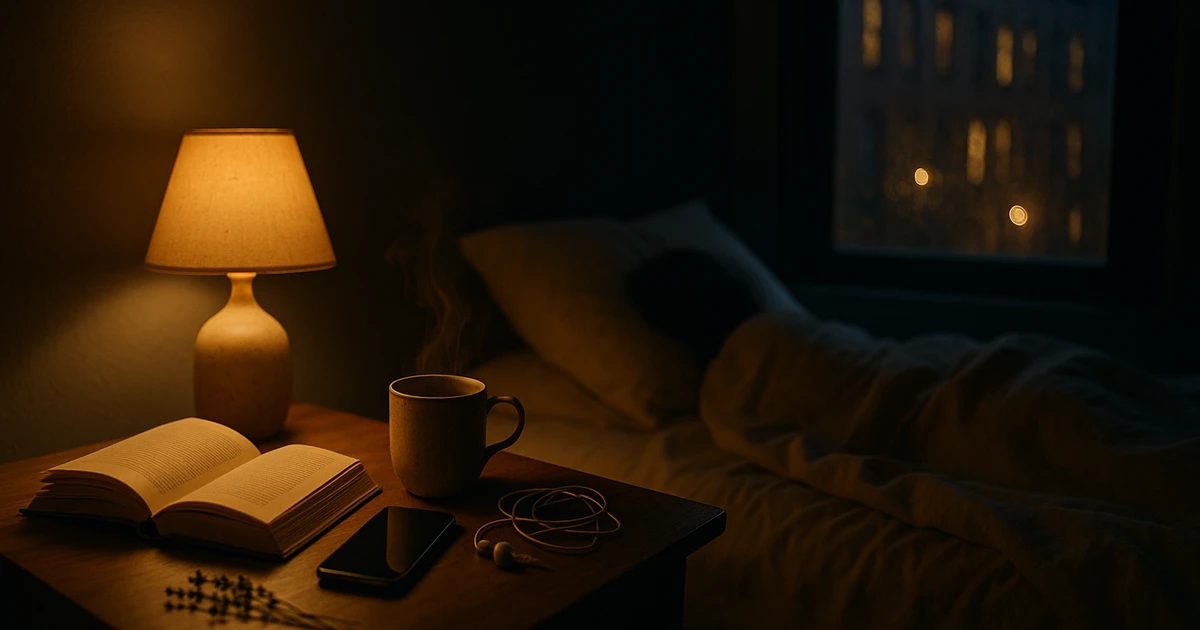

Bedtime stories for adults are narratives designed to calm the nervous system and guide listeners into sleep through soothing voice, gentle pacing, and carefully crafted storylines that avoid tension or excitement. Unlike traditional audiobooks, these stories use specific techniques-slow narrative rhythm, descriptive imagery, repetitive patterns, and calming voice tones-to activate the parasympathetic nervous system and reduce cognitive arousal.
Research on sleep hygiene and relaxation techniques shows that structured auditory relaxation consistently improves sleep onset. While childhood bedtime stories helped us transition from wakefulness to sleep, adult sleep stories recreate that neural pathway using age-appropriate content and evidence-based relaxation principles.
This practice has grown from niche wellness tool to mainstream sleep solution, with sleep story libraries now featuring thousands of titles across multiple platforms.
Why Bedtime Stories for Adults Actually Work
Bedtime stories for adults work by redirecting attention away from anxious thoughts and into a structured narrative that requires minimal cognitive effort. This process reduces the mental hyperarousal that often prevents sleep.
The mechanism involves several neurological pathways. First, listening to a story engages the default mode network-the brain regions active during rest and internal focus-while simultaneously reducing activity in executive function areas responsible for problem-solving and planning.
Second, the predictable pacing and gentle content signal safety to the amygdala, the brain's threat-detection center. When this structure registers safety, it allows the body to initiate sleep processes. Third, the auditory focus creates what researchers call "attentional anchoring"-your mind has something to follow instead of wandering into worry loops.
- Attentional anchoring
- A cognitive technique where attention is gently directed toward a single, non-threatening stimulus (like a story) to prevent mind-wandering and reduce rumination before sleep.
Unlike meditation, which requires active awareness, or music, which may not occupy enough attention, sleep stories hit the optimal balance: engaging enough to redirect thoughts, but not stimulating enough to increase alertness.
The Science Behind Slower Sleep Onset
Read also : Sleep meditation
Adults who use structured relaxation techniques before bed experience measurably faster sleep onset compared to those who attempt to fall asleep without sleep aids or distraction techniques.
Sleep onset-the transition from full wakefulness to sleep-typically takes 10-20 minutes for healthy adults. However, anxiety, stress, and cognitive arousal can extend this period significantly. International sleep health organizations recognize that pre-sleep cognitive activity is one of the primary barriers to timely sleep onset.
Sleep stories address this by creating what sleep researchers call a "cognitive landing path"-a gradual reduction in mental activation that mirrors the natural descent into sleep. The story provides just enough narrative interest to occupy working memory without triggering emotional arousal or intellectual engagement.
The voice itself matters enormously. Slower speech rates (around 100-150 words per minute, compared to normal conversation at 150-180 words per minute) match the natural slowing of cognition during sleep onset. Consistent tone without dramatic inflection prevents startle responses that would re-activate alertness.
What we see at Nala
Our catalogue includes 35 adult sleep stories designed specifically for sleep onset, created by Soren and Elena. We observe that users most consistently fall asleep during stories with nature settings, slow-paced journeys, and detailed sensory descriptions-mountain walks, coastal landscapes, forest paths at dusk. The Sovaluna 5-phase method, developed specifically for deep sleep, combines these narrative elements with somatic awareness, vagal tone activation, respiratory pacing, progressive relaxation, and frequency-based sound design. Users report that this layered approach addresses multiple sleep barriers simultaneously: physical tension, mental arousal, and nervous system activation.
What Makes an Effective Sleep Story
An effective bedtime story for adults contains specific structural elements: slow pacing, descriptive rather than plot-driven narrative, absence of conflict or tension, repetitive patterns, and sensory-rich imagery.
The best sleep stories avoid cliffhangers, dramatic reveals, or complex character development-all elements that would engage the problem-solving prefrontal cortex. Instead, they use meandering narratives: a walk through a garden, a train journey through countryside, a visit to a quiet bookshop.
Voice quality matters as much as content. The ideal voice is warm, consistent in volume, with descending pitch patterns that mimic natural sleep speech. Whispered or ASMR-style voices work for some listeners, while others prefer conversational tones.
Core elements of sleep-inducing stories
- Pacing: 100-150 words per minute with frequent pauses
- Content: Descriptive, non-threatening scenarios without conflict
- Structure: Meandering rather than goal-oriented plot
- Imagery: Multi-sensory descriptions (visual, tactile, auditory)
- Length: 20-45 minutes, allowing sleep before the ending
- Voice: Consistent tone, gentle inflection, descending pitch patterns
- Descending pitch pattern
- A vocal technique where sentences end with falling rather than rising intonation, signaling completion and rest rather than continuation or questioning, which naturally cues the listener toward relaxation.
Bedtime Stories vs. Other Sleep Aids
Read also : Sleep stories adults
Bedtime stories for adults occupy a unique space in the sleep aid landscape, offering benefits distinct from meditation, white noise, music, or pharmaceutical options.
Compared to meditation, sleep stories require less training and no active participation. Meditation asks practitioners to maintain awareness-a skill that takes practice. Sleep stories simply ask you to listen, making them accessible to anyone regardless of experience.
Compared to music, stories provide narrative structure that more effectively occupies the mind. Music can work well for some, but others find their thoughts still wander. The story provides a "mental track" to follow.
Compared to white noise or nature sounds, stories engage higher-level cognitive processes while still promoting relaxation. They satisfy the mind's need for something to process without demanding alert attention.
| Sleep Aid | Attention Required | Learning Curve | Mental Engagement | Best For |
|---|---|---|---|---|
| Bedtime stories | Passive listening | None | Moderate, descending | Racing thoughts, anxiety |
| Meditation | Active awareness | Moderate-High | High, sustained | Experienced practitioners |
| White noise | Background only | None | None | Environmental noise masking |
| Music | Passive listening | None | Low-Moderate | Emotional regulation |
| Audiobooks | Active listening | None | High, sustained | Entertainment (not sleep) |
Who Benefits Most from Adult Sleep Stories
Bedtime stories for adults particularly benefit those whose sleep difficulties stem from cognitive rather than physical causes-racing thoughts, anxiety, work stress, or habitual rumination.
If you find yourself lying awake replaying conversations, planning tomorrow's tasks, or worrying about future events, your primary sleep barrier is cognitive arousal. Sleep stories directly address this by giving your mind something else to process.
They also help those who sleep alone or have experienced the loss of a partner. The human voice provides comfort and a sense of presence that can ease the emotional discomfort of sleeping alone.
Common profiles of sleep story users
- Professionals with high-stress jobs who can't "turn off" work thoughts
- People with anxiety or generalized anxiety disorder
- Those experiencing major life transitions (career change, relocation, relationship changes)
- Individuals with mild-to-moderate insomnia without underlying sleep disorders
- People who experienced bedtime stories as children and find them comforting
- Adults who sleep alone and find a voice presence soothing
Sleep stories work less effectively for sleep issues caused by physical discomfort, sleep apnea, restless legs syndrome, or chronic pain. In these cases, the primary barrier isn't cognitive, so addressing the mind alone won't resolve the sleep difficulty.
Building a Sleep Story Practice
Starting with bedtime stories for adults requires minimal setup but benefits from consistency and the right listening environment.
Begin by choosing a dedicated time for sleep-going to bed at the same time each night strengthens your circadian rhythm. About 30 minutes before this time, begin your wind-down routine: dim lights, reduce screen exposure, and prepare your sleep environment.
Select a story that appeals to you thematically-nature, travel, historical settings, or cozy domestic scenes. Most sleep story platforms categorize by theme. Length matters: choose stories 25-45 minutes long, assuming you'll fall asleep before the end.
Position your device so you can start the story without needing to interact with it again. Many users place their phone face-down on a nightstand or use a sleep timer. If using headphones, choose comfortable sleep-specific designs or play audio through a speaker at low volume.
Give the practice at least 5-7 consecutive nights before evaluating effectiveness. Your brain needs time to create a new sleep association. The first few nights may feel strange or unfamiliar, but most users report the practice becomes more effective with repetition.
- Sleep association
- A learned connection between a specific cue (like a bedtime story) and the sleep state, created through repetition. Over time, the cue itself begins to trigger sleepiness.
How Nala Can Help You Sleep Better
Nala offers 35 adult sleep stories narrated by Soren and Elena, designed specifically for sleep onset using evidence-based relaxation principles. Stories feature diverse settings-from Scottish highlands to Mediterranean coastlines-all crafted with slow pacing, sensory-rich descriptions, and calming narrative structure.
Beyond stories, Nala includes the Sovaluna 21-day program, our signature deep sleep method combining five phases of nervous system regulation. You'll also find Onyx's deep sleep sessions with sound healing, Zara's ASMR sleep experiences, and 37 mixable ambient sounds to customize your perfect sleep environment.
For those new to sleep practices, the Sleep 14-day program provides structured guidance, while 14 free SOS sessions offer immediate support during acute stress or sleeplessness. All content is available in both English and French, with a 7-day free trial to explore what works best for you.
Learn more about the Sovaluna method
Conclusion: A Simple Practice with Profound Impact
Bedtime stories for adults represent a return to a practice we understood intuitively as children: the human voice, a gentle narrative, and the safety of a predictable routine create ideal conditions for sleep.
Unlike complex sleep protocols or pharmaceutical interventions, sleep stories require no expertise, have no side effects, and can be started tonight. They address the most common modern sleep barrier-the overactive mind-with a solution that feels comforting rather than clinical.
Whether you struggle with occasional sleeplessness during stressful periods or face chronic sleep onset difficulties, adding a sleep story to your bedtime routine offers a low-risk, high-accessibility intervention supported by our understanding of cognitive arousal and sleep physiology.
The practice works best with consistency. Choose a story, create your listening routine, and give your nervous system permission to rest.
Sources
- National Health Service (NHS), Sleep and tiredness resources, sleep hygiene recommendations
- National Institute for Health and Care Excellence (NICE), Guidelines on sleep disorders and non-pharmacological interventions
- World Health Organization (WHO), Sleep health information and recommendations